Jumat, 28 September 2012

Writing as cognitive tool


It is amazing how much has changed the technology applied to writing in 150 years, from writing with a goose feather dipped in ink which allowed ideas flowing on paper to typing ideas on a screen.

Technology of writing has not changed too much if we think about it, feathers were used so many years, and then during century XIX fountain pen began to be develop by several inventors who made few changes to the original designs and the ball point pen was issued at 1888.

During century XX most of us learned to use a pencil or a pen and when we had enough things to write down, we changed and began to try with a keyboard, pressing keys, wasting paper when we had a mistake at any part of the page, but not many years later, computers came with screens added to keyboards and now, here we are touching letters on a screen. It seems writing is easier, and there is no doubt taping on a screen and hand writing need different skills.

Typing on a screen made life fun to some persons, for example, it is very obvious when a left-handed child write by hand, because their body needs a particular position, if they can’t find it their writing is a disaster. On the keyboards or touch screens, position does not matter; they are designed to use both hands. 

In case we need to appreciate even more the computer tablets or smart phones, they are fun and attractive to children, it seems they have a kind of magnetic glue specially designed for children hand, maybe that’s the reason parents buy them to give more exposure than never before. In a study conducted in The United States, parents said that having kids give them extra justification to buy devices.

The article entitled the writing on screen shares a historical tour around the development of writing, and remains the value of handwriting as a personal characteristic, because things can be said based on the way we draw every idea, through our personal inspiration using words.

At this particular point, it’s important to highlight, while handwriting requires specific movement to outline each of the letters, which means the motor and visual recognition of every letter, this is not need in so sophisticated way with keyboards, but no matter, we must differentiated every letters and the space to write. Of course, typing only makes recognition of keys but it’s not necessary to pay attention to space into the sheet because applications do it automatically, and some persons actually don’t need to see the keyboard, even we know this can produce the common finger’s error.
 
However writing it’s much more, it’s a process that can be highly specialized, with basic needs like having an idea to share, conceptual thinking, the transfer of knowledge, judgment, critical analysis, sometimes induction, deduction, attention to details, troubleshooting and empathy to mention just a few needs.

We can’t deny devices make our writing easier since there are application to correct spelling (when the word is in the dictionary) and sometimes helps with the syntax, and this add to writing a complete new perspective; furthermore keyboards allow a speed of writing hardly reachable by the hand writing, (except in the case of doctors, whose writing is incomprehensible), and also allow the use either hands, or just a finger, unlike the handwriting.

But no matter if we write with a keyboard, a pen, or a pencil, the most important skill will be to have a clear idea about what to share, because writing is much more than just unites letters. I know most of us started our writing copying letters on a sheet, writing is a deeper cultural tool which needs to develop ideas and write them correctly having on mind a reader. Writing is trying to take attention of a person for a moment and at the end of our ideas leave something to think about.

Writing can be a knife on our neck or an award, persons judge us by the details of our writing; strictly speaking, the modeling of the letters on a surface could be a reflex of the character of a person and talking about learning, depending on how the brain processes the information, words can be a door to our inner world.

Now more than never before, authors require being very careful how they share their knowledge, especially with publication is online, since words can have different meanings at other contexts or cultures, and this determines the impact of a simple phrase.

I can’t avoid saying that technology has changed the way we say things. When we were students, our favorite teacher was who allowed us to write just few pages, and it was even better if he or she added the phrase: what matters are the ideas and not the number of words.

Now we hate Twitter by the restriction that involves, how is it possible to explain to someone the theory of multiple colors in black and white if you only have 140 characters?. 

Facebook?, how can we write a simple idea when there are 3 thousand people saying things at the same time? What I said is pushed to the bottom or pushed high if by any reason my comment opens a door to more than one meaning and begins a debate.

How can our words touch to readers? Or even more: how can we develop a joy for writing and share ideas on others?. I have two ideas around this topic:
            1)    Writing is a cultural tool, beyond the device we use, it’s much more than unite words   
                          2) As a tool, it must become a need, not an obligation.

Writing must be a used as communication tool, from simple task to complex, like a to do list, a text message to ask simple things, a letter to Santa Claus, a short story. Have you tried to say a story with 5 words?; children must learn to write, unless you want to read the complaints of teachers, and no desire to upset anyone, I think children never do it by themselves if we don’t invite them to do it, if writing is not seen as a cultural need, it will see as a school torture.

Let’s stop saying people don’t know to write, let’s find strategies to make them write, and every step counts, from text messages, twitter, facebook, that’s the beginning for a book, let’s stop saying: you don’t know, let’s say: that’s a cool phrase!.

Handwriting and the writing with the keyboard are complementary, following the rule more is better, so it does not reason to drop skills, but combine them. Children feel more attracted to screen than a pencil, that’s why every day there are new apps trying to emulate handwriting on the screen, and, we never know, some can feel pencil is interesting, at the end the device is just a tool.

Instead of saying that someone has bad spelling or that his or her writing is incomprehensible, and that person is not enough intelligent, we should spend a minute and appreciate even one logic sentence, make it fun, open other channels, for example for some few persons like how the ink smells,  some pens are more fun than others. Personally my hands have typed so much than using a pen is painful, but the most important is find a way to open of opportunities and discover a nice reason to share ideas, without forgetting, however, that there are more than one eloquent means of expression, whatever the way you decide, handwriting, typing or taping, are just a mean the goal is not drawing letter, but telling ideas.

I want to thank to the wonderful spanish artist  Antonio Alonso Lopera because his drawings are illustrating this post. He gave us a good example of creativity because he draws with a Pen Bic, sometimes words come in images. You can enjoy his art at his facebook page Antonio A L Arte or enjoy his blog: http://arteaal.blogspot.com/

Alma Dzib Goodin

If you want to know more about my writing, please visit: http://www.almadzib.com

References:

Barragan, MA. (2012) Thinking in the internet age. Aeromexico Clase Premier. 3 (35) 78-80.

Bells, M. (W/D) A brief history of writing instruments. Available at: http://inventors.about.com/library/weekly/aa100197.htm

Casanova  Cardiel, H. (2012) México, con mayor número de analfabetas que hace poco más de 10 años. Boletin UNAM-DGCS-550. Available at: http://www.dgcs.unam.mx/boletin/bdboletin/2012_550.html

Dzib Goodin, A. (2011) Reading, and writing: more than just unite letters. Available at: http://talkingaboutneurocognitionandlearning.blogspot.com/2011/11/reading-and-writing-more-than-just.html

Dzib Goodin, A. (2011) The difficulties with the process of reading and writing. Available at: http://talkingaboutneurocognitionandlearning.blogspot.com/2011/12/difficulties-with-process-of-reading.html

Historic Connection (W/D) The history and development of writing. Available at: http://historicconnections.webs.com/historyofwriting.htm

Martina, E. (2012) The writing on the screen. Available at: http://ivichiesays.WordPress.com/2012/02/11/the-writing-on-the-screen/

Moses, L. (2012) Data points: wired child preescolers have more exposure to electronics than ever. Available at: http://www.adweek.com/news/technology/data-points-wired-child-143732

 NHS Choices. (2011) Does typing make learning harder? Available at: http://www.nhs.uk/News/2011/01January/pages/writing-versus-typing-for-learning.aspx


Selasa, 28 Agustus 2012

Learning and evolution

When the idea of studying learning began to grow in my head I was sure it would be an easy task, the library had at least 100 aisles dedicated to different strategies, models, explanations, theories about how it should be taught. Education, teaching, or learning problems were kind of synonyms of learning.

After reading all the books, magazines were a good source of inspiration, but only created more notes into pages of my notebooks which ended quickly and I finally decided to look in the brain, it was the logical step, because it’s where learning is scanned, processed and stored. 

I believed it was going to be easy to find answers in this lump that all of us  carry all on our shoulders, and it seemed an easy journey, after all,  how much can fit in an average area of 1130 cm3?.

My trip was from structures with their latin names to the connectome, which is a map of the neural connections, and seeks to describe the brain structure, as well as the genome is more than just a juxtaposition of genes, the set of neural connections is much more than the sum of its individual components (Biswal, Mennes, Zuo, Gohel, Kelly Smith; Beckmann, Adelstein, Buckner, Colcombe et al., 2010).

Connections 

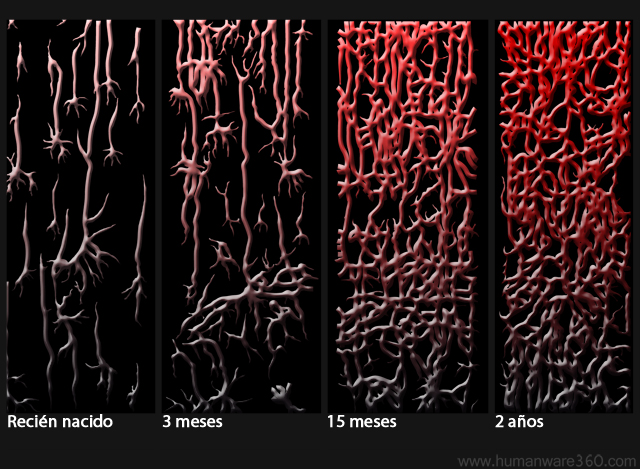
A great expert in this topic, Sebastian Seung (2012) explains  that the connectome contains millions of times more connections than the letters of the genome, and each one will be building specific connections, all those networks is the personal  connectome, which is created on 4 principles: reweightingthis means changes in the strength of the synapses; reconnection is the creation and elimination of synapses; rewiring that is the creation and elimination of neuronal branches and regeneration which is creation and elimination of neurons.

If neurons were all, it seemed logic that understanding learning should not take me more than 10 years, but as Dehaene (2011) figured out,  brain represents the reply of the slow evolution of species governed by the principle of the same natural selection that has been perfected over the years allowing the brain to optimize the way in which processes the huge flow of sensory information received to adapt the reactions of the body to a competitive and hostile environment.

If the key of learning is exclusively in the brain, then the idea of learning adapting to the environment was valid and I mistakenly arrived to propose that learning allowed this adaptation, I cannot deny the error because I published in different articles. I changed my mind when a biologist made me remember that other species adapt, including proteins as I explained in another entry on this blog (Dzib Goodin, 2012). Prions took away my sleep for a while.

So it was time to seek the evolutionary mechanisms. Finally we are the sum of the processes of changes and adaptations.

Years of change

Someone kindly suggested me to explore theBaldwin effect, also known as ontogenetic evolution which is a theory of the likely evolution process of learning, which was published for the first time in 1896. The theory proposes a mechanism for learning ability in general, based on the idea of selected descendants of a group can have greater capacity to learn new skills rather than simply the abilities granted by the genetic code which is relatively rigid.

The idea sounds very logical but theory has been controversial from the modern evolutionary synthesis, and it has not been easy to prove the occurrence of the phenomenon. Personally I'm going to start documenting my summer battles between weeds, slugs, and snails to keep my gardens healthy. 

The main limitation of the Baldwin effect from Hinton and Nowlan point of view (1984) is the fact this idea is only effective in spaces that would be difficult to find, very specific species to which it is possible to continue without an adaptive process of restructuring from the space. But for those biologists, who say that wilderness areas are well structured, the Baldwin effect is an important mechanism to allow adaptive processes within the body to greatly improve the space in which a species evolves.

This theory led me to find something else, and I returned to an old topic, Can you believe the evolution of brain processes has been best explained by theorists of artificial intelligence?.

Some researchers has the assumption that brain can adapt and learn from past experience, because the specific evolution is not only inherited behavior but adds inherited goals that are used to guide the learning under the orders of a genetic code that has two components in the species. The first component is a set of initial values to create a network of action which maps the sensory input to behavior, this is presented as a set of innate behaviors that are inherited from the parents (Stefano, Elman, and Parisi, 1994).

The example that comes to my mind is a newborn baby, who is beginning to recognize the environment, his initial reactions are sensory, as Piaget recognized from the last century. Some of these reactions begin to distinguish between the species, for example, reflexes are becoming more sophisticated, and some babies show signs of maturity, while others follow a different pattern of development.

The second component is a network of evaluation,  this focused action on the sensory input to a value scale that help to move from a bad to a good situation by changing its weight in the action of the network during the process and that the individuals maintain as learning goals (Stefano and Parisi 1994).


There is no a bigger pleasure than observing a baby who is in a dilemma. If he manages to control the motor actions and builds the network between look at an object and take it, how does he react when despite the same movements, but the object doesn’t move?. His first reaction is: hey, come to me, I am taking you!. Other babies will try it more than 5 times, while some observe the problem, and maybe one or two will try to solve the problem crying, explaining to the toy that mom will know soon about his rebelliousness and nobody plays with mom.

In this sense, it can be said that the evolution of neural networks contains information not only in genetic terms, but also a collection of behaviors developed by the ancestors and this can be understood as a culture(Dehaene, 2012, Conrad, 2004).
 
It is then that culture has a major role since the adaptations in the environment are not always determined by closed codes and therefore not can become stronger than those established by the selection (including the changes in the social environment). The best example of this is the language, since previously the specie was not dependent on the speech, until it begin to evolve the language skills, is so development processes that had not participated previously in the language can be selected object because of its effects on the acquisition of the language, resulting in the modification of older adaptations (Barret, 2012).

However, culture is not absorbed in the whole brain how explains Stanislas Dehaene (2004) in his theory of neuronal recycling, he says that cultural purchases can take place in a limited surface area bounded by the cerebral cortex. As an example, the author analyzes reading and arithmetic that have greater reproducibility in the neo cortex.

This idea has been explored in more than one research, for example in an article published by Conrad (2004) it presents a theory about the formation of the central nervous system based on the processing of information from the description of the molecular biological systems. He explains that the central nervous system consists of several types of unitary regions, of which there are many interchangeable replications.


Each region contains neurons whose power is determined by the enzymes that recognize the specific input patterns to that region specify by genes inherited or cultivated. Finally, the central nervous system has selection circuitry that put test and evaluation of different regions, determining control of the production of genes on the basis of such an assessment. 

At the same time, there are genes whose production is stimulated in a diffuse way in regions in which occur to transform other relevant regions of the same type. In this sense, the function of the molecules is the same in these new regions because the structure of the tissue and cell properties is the same. 

This makes possible a process of trial and error to learn mediated by the same mechanisms as the natural evolution, except that it is more efficient because the circuits of selection. Systems that operate on the previous basis are capable of performing any executable as a conventional computer, but with significant restrictions on the programming. Thus, these systems are also (structurally) simpler than more susceptible to learning and evolution and conventional information processing devices (Conrad, 2004; Changeux and Dehaene, 2000).

It seems during the evolution of the brain the properties of its tissues development are subject to evolutionary change from the effects on the phenotypes of the brain. This can be initiated by the changes in systems development (for example, through mutation), changes in the environment in which they develop (culture, environment), or both (Barret, 2012). 

An idea of how happens this is provided by Fernando, Szathmary, and Husbands (2012) who claims  that Darwinian evolution can happen in the brain during, for example complex thought, or the development of language in children, though nothing further than the level of the synapse is subject to Darwinian evolution in the brain. Which confirms the affirmation of Seung: we are our connectome.

Evolutionarily, the advantage of having algorithms of replication occurring by natural selectionis not observable to the naked eye, compared to the instrumental learning models (Fernando and Szathmary 2010). In fact, the notion of the dynamics of replication in the brain remains controversial and the creation of neural networks is a cost process that depends on technological development, example of this is the Blue Brain Project.

Artificial neural networks

Thus, the technological advances to make possible the creation of neural networks that tries to simulate the biological capacity to adapt and learn from past experience that has the brain. 

However, even for experts in neural networks, the task of explaining the learning mechanisms have not been easy, because as explain Iriki and Taoka, (2012) brain evolution has three essential components, one developed by multisensory integration (sight, hearing, smelling, feeling) and transformation of coordinates for the control of movements in the living space is an essential function of the nervous system (what is known as ecological niche). But this neural enhancement is not an isolated event, since it allowed the brain to move processing to the summary of information, through the implementation and reuse of the existing principles of information processing space that adapted to the subjection of mental functions and which ultimately led to the development of the language with which it was possible to communicate locations or spaces (which resulted in a cognitive niche). This was also useful handling of the image of the body in space, which became essential for the handling of tools, giving as a result the acceleration of interactive links between cognitive, neural bases cognitive and gave way to the third niche which is building.

Just in case here sounded a simple explanation, complex that a baby may formulate coordinated words, you must know how to use the tongue, move it in a coordinated manner, and learn to control the air, when it manages to dominate the difference between a sound and reaching a word to take the race to perfect this ability. I personally really enjoy these attempts, babies range from simple ma, pa, aba sounds to words: mom, wad, water. Once they have established that, begin to use the tools and parents are scared when they see the child with the Ipad or the cell phone in their possession, nothing more fun to do than using a pencil, or a touch screen. When parents learn to relax, and children send their first text message, or read their first book, tools have sense. Hence to describe the world.

This explains that a modified human environment exerts pressure on future generations to adapt to it, perhaps through the acquisition of new resources that have to adapt to the different organs, with which is possible to explain plasticity induced epigenetically (this term refers to the study of non-genetic factors involved in the development of an organism), including the development of mechanisms of learning involved in such processes. In this way, the additional genomic information can be transmitted between generations through mutual interactions between neuronal, ecological niches and cognitive domains. This scenario locates the brain as part of a comprehensive ecosystem in evolution (Iriki and Taoka, 2012).

It is so arises the neuroevolucion as a field of study, which seeks the creation of artificial neural networks (ANN) through evolutionary algorithms, and sometimes has focused its efforts on static neural networks that cannot change its function during lifetime, since these are the easiest to replicate (Miikkulainen, Feasly, Hohnson, Karpov, Rajagopalan, Rawal and Tansey, 2012; Gauci and Stanley, 2010).

However, a serious problem with the evolution of adaptive systems is that learning to learn is very misleading, as describe Risi, Hughes and Stanley (2010), because a principle is easier to improve physical condition without the ability to learn, evolve by that is not based on the heuristic adaptation. This is learning a stiff task with no greater decision making, which is a model away from reality. 

In their study, the authors find as a conclusion that novelty search has the potential to foster the emergence of adaptive behavior in reward based learning tasks, which opens up a new direction for research in the evolution of neural networks of plastic, which makes it more interesting and easy to learn adaptive behaviors that had been difficult to observe in human models.

But is Henry Markram, who has a good idea about this, he says brain has led billions of years evolve and has many rules, so the challenge of the neuroevolucion is to describe them carefully using mathematical laws and if it is possible to achieve that, the challenge will then be to build a realistic model of the brain (Kushner, 2012).

Brain and school

Although it sounds like a foolish, learning process has a long way, developing its own rules and the school as an institution should not ignore, but does it. The result is not only unhappily educated children, but jobless adults. But, there is no perfect educational system, even the brain has established laws, it modifies them generation after generation, trying to find a biological balance.

Of course, it’s possible to expect a programming expert to design an application that connects through an interface with a single click, so we could learn anything, even those for which we are not physically fit, as in the The Matrix movie, but while that happens, it is worth putting the brain in the classroom and understands its mechanisms. 

It is not my idea that teachers know neuroscience, that is not the goal, but at least I would like to explain to teachers when they  see a child with learning problems they can see him as a problem of education, since  the brain has adapted and survived on the face of the Earth much more better than any curriculum has done so. 

Part of that evolution implies as studies indicate, the brain changes all the time, and in this sense, if a child is not capable of running a task today, far from tag it, should think that under the correct strategies, he or she will do it, with their own pace, accuracy and specificity, different than others, after all, there is nothing more impressive being unique different and special.

The success of the brain is such that it has been able to look to infinity and beyond, the Moon was not its limit, right now is exploring Mars, has done its utmost, has grown, invented, fantasized and made possible what was thought impossible, in a 1130 cm3average space., imagine now that they will be able to make many with a common goal: an effective teaching
 

If you would like to know more about my writing, you can visit my web site,
http://www.almadzib.com/


REFERENCES

Ackley D., and Littman, M. (1991) Interactions between learning and evolution. In Artificial life II, SFI studies in the sciences of complexity. Vol X edited by CG Langton, C Taylor, JD Farmer & S, Rasmussen. Addison –Wesley. United States


Barret, HC. (2012) A hierarchical model of the evolution of brain specializations. Proceedings of the National Academy of Science of the United States of America. 19 (Supl 1). 10733- 10740.


Biswal BB, Mennes M, Zuo XN, Gohel S, Kelly C, Smith, SM, Beckmann, CF, Adelstein, JS, Buckner RL, Colcombe S, et al (2010) Toward discovery science of human brain function. Proceedings of the National Academy of Sciences 107 (10) 4734-4740 


Conrad, M. (2004) Evolutionary learning circuits. Journal of theoretical Biology. 46 (1) 167-188.


Dehaene, S. (2004) Evolution of human cortical circuits for Reading and arithmetic: the neuronal recycling hypothesis. In S. Dehaene, J. R. Duhamel, M. Hauser & G. Rizzolatti (Eds.), From monkey brain to human brain (2004). Cambridge, Massachusetts: MIT Press.


Dehaene, S. (2011) The number sense: How the mind creates mathematics. Oxford University Press. USA.


Fernando, C., and Szathmáry, E. (2010) Natural selection in the brain. In B., Glatzeder, V. Goel,  and A. Muller (Eds) Towards a theory of thinking: building blocks for a conceptual framework. Springer. Germany.


Fernando, C., Szathmáry, F., and Husbands, P. (2012) Selectionist and evolutionary approaches to brain function. A critical appraisal. Frontiers in Computational Neuroscience. 6 (Art. 24). Disponible en http://www.ncbi.nlm.nih.gov/pmc/articles/PMC3337445/pdf/fncom-06-00024.pdf.


Gauci, J., and  Stanley, K.O. (2010) Autonomous evolution of topographic regularities in artificial neural networks. Neural Computation 22(7)  1860-1898.


Hinton, GE., and Nowlan, SJ. (1987) How learning can guide evolution. Complex Systems. 1. 495-502.


Iriki, A., and Taoka, M. (2012) Triadic (ecological, neural, cognitive) niche construction: a scenario of human brain evolution extrapolating tool use and language from the control of reaching actions. Philosophical Transactions of the Royal Society Biological Science. 367. 10-23.


James Mark Baldwin. A New Factor in Evolution. American Naturalist 30, (1896): 441-451, 536-553. Disponible en http://www.brocku.ca/MeadProject/Baldwin/Baldwin_1896_h.html


Krushner, D. (2011) The man who builds brains. The Brain, Discovery Magazine. Disponible en red: http://discovermagazine.com/2009/dec/05-discover-interview-the-man-who-builds-brains


Miikkulainen, R., Feasly, E., Hohnson, L. Karpov, I., Rajagopalan, P., Rawal, A., and Tansey, W. (2012) Multiagent learning through neuroevolution. Advances in Computational Intelligence. 7311. 24-46.


Nolfi, S., and Domenico Parisi (1994). Good teaching inputs do not correspond to desired responses in ecological neural networks. Neural Processing Letters 1 no. 2 (11/94) pp. 1-4.


Nolfi, S., Elman, J., and Domenico Parisi (1994). Learning and evolution in neural networks. Adaptive Behavior 2 (1994): 5-28.


Risi, S., Hughes, CE., y O Stanley, K. (2010) Evolving plastic neural networks with novelty search. Adaptative Behavior. 18 (6) 470-491.


 Seung, HS. (2012) Connectome: How the Brain's Wiring Makes Us Who We Are. New York: Houghton Mifflin Harcout.

Jumat, 27 Juli 2012

Should teachers know science or neuroscience?


This question is constantly asked at different forums, science blogs and messages about education such as specialized in neuroscience and science. I personally read each one as because is the main theme of my writings. Yes, I think and believe that neuroscience can do a lot for education and my argument is time to put the brain in the classroom, and I do not tire of saying that science education benefits to any country at all levels, especially the economic. Can you interpret my phrases as you like, there is no a recipe.

My problem arises when other writers say: teachers should know neuroscience, and that joins a long list of duties, like teachers should know physics, math, history, chemistry, biology, astronomy, so they would teach it properly to students. Virtually any topic in which someone is expert, teachers must master it, so future generations can have a scientific education.

Of course the huge list of topics that we believe teachers can be experts, are added cleaning bugers, how separate fighters, reading of hieroglyphs, decryption key, taught to read and write, how to respond to questions such as: can I go to the bathroom?, can I deliver my homework tomorrow?, how do you know that I copied this from Wikipedia?, or what will you do to help my child with writing?. 

If teachers should be experts in so many fields, they would deserve to earn a higher salary. Being a teacher would be a good profession, (it doesn't mean is not, but it would be a better profession) and they would have enough money to read specialized magazines and attend all meetings, conference and forums organized by those who claim to know how to teach better and are part expensive conferences to share knowledge. Sharing is just a say by those experts in science, because they do not speak with simple mortals, they only charge a high bill by let you see them a couple of hours, recommending to buy their books, and follow them in social networks. 

If teachers have questions or want to share any idea, they have permission to speak. It doesn’t mean those questions will be answered, those ideas are not relevant. The relevance is decided by the expert, not you.

The question is then whether teachers should know science and how much they can apply it in their classroom, in a society that isn't interested in science.

Let's  split  this question, which is not as easy as it seems. 

The relationship of science to society

Once I read that it can’t be taught something that is socially shared, because teachers work with which society gives them to shape. If socially you aren't literate scientifically, it is not possible to provide the science from the experts, those lucky ones who have taken advantage from their enormous passion for a subject, often supported at home, because everything is much easier if you have other supports, in addition to school.

When people think about scientists the image is a brilliant mind able to respond to everything and understand the complexity of the world, it's partly an image that scientist themselves have created, however, science in numbers looks far from society.

Let me share some data. Between 1996 to 2010 were published 5,322590 Scientific articles in United States, and from those documents 4.972 679 are quotable, does that sound like many articles?, well, what about if we compared them with the population of The United States, 313,967,000 persons means that they are not so many articles, and if you accept that not everyone can read them, and each article sometimes costs between 20 and 40 dollars, maybe we can begin to see some distances.

The countries that follow in the list with more scientific production are China with 1,848,727 articles, but with a population of 1,347,350,000 persons; United Kingdom added 1,633,434 articles, and has a population of 62,262, 000 persons. 

At the other extreme of the data, The Vatican City State published 4 articles in the same period, but it has a population of 800 persons. The island of Saint Helena has a population of 4,255 and 1 published article. Of course the proportion is abysmal among the countries most gifted of scientific support. 

Does it look like The United States is a scientifically literate country?, I don't think so, because one of the topics given more headache is how to make that science can have better results. 

In a study applied in 2009 by the Organization for Economic Co-operation and Development to students 15 years of age between 65 countries, United States ranked 23th in science and 31st in mathematics. 

It is not the idea of this article to discover the black wire, but I think that the problem is between the distance of science with society. To argue this point, I propose some comparisons: Carl Zimmer is followed by 922 050 persons on Google plus, Hugh Jackman has  2, 878,747 followers, Daniel Tosh has 6.2 million followers on twitter. 

But it seems that people can be a little interested in science, if you can understand it, because if we look at the most popular scientific websites is that visits that are made to them are distributed as follows:
1. How stuff works?,  12,000,000! Clearly , it's good to know, n how everyday things work and if someone explains it and you enjoy this, perhaps it's easy to understand it!.
2 NOAA 10,000,000
3 Discovery Channel 9,400,000. What teacher has not heard: I saw it on Discovery Channel?.
4 NASA 8,900,000
5 Science direct 4,500,000
6 Science Daily 2,400,000
7 Nature 1,800,000
8 Treehuger 1,700,000
9 PopSci.com 1,400,000
10 Science Blogs 1,250,000
11 PhysOrg 1,200,000
12 New Scientist 1,000,000
13 Live 950,000 Science
14 Space 750,000
15 Network Orbit 600,000
It must be considered that these sites are not only reached in The United States, but if the world's population is estimated in 7 billion of persons, readings are reduced to very little, and one more comparison:  Lady Gaga has 27, 815 976 followers on twitter. Does this sound like she has more fans than Nature?.

But if we look again at the list, its possible to observe the level of complexity on scientific topics is inversely proportional to the audience, this means less complexity, more audience.

Why don’t people read nor understand science?

I learned many years ago there are three levels of science, basic science, where are those of highest level, sometimes in laboratories with expensive equipment, often trying to give answers to the most complex things in the universe. Between them and simple mortals, they are those who interpret those complex things and have the ability to explain them with simple words. Sometimes they are scientists, sometimes they have enough passion for some topics, but without their ability to explain in words what scientists write based on molecules or mathematical calculations, it would be difficult to understand much.

Finally there is the applied science, or those who take what the second level and put it in action. Sometimes they are mercenaries and science are expensive, but something to eat.

Many journalists and scientific bloggers are at the second level, sometimes communicate directly with scientists, although they can feel fear of scientists´ comments,  saying  simple mortals are wrong or they do not understand beyond few letters (this was Carl Zimmer's  comment of on twitter).

This is the reason why there are manual to argue with scientists as the written by Jacquelyn Gill, who explains that scientists only talk among themselves and only accepted evidence of writings that have been reviewed by peers, their peers. Even when if at some cases it has been proof that articles can be wrong or even based on false evidence. But it seems there is a tremendous competition between them and sometimes unfair. In some countries it makes sense, when the programs for science and Academy depends on limited budgets, and it is distributed among so many brilliant minds just few coins.

Gill explains that if an idea was written in a blog or in a magazine that does not have some credibility, it is simply disqualified by the experts. In addition, if simple mortals are not capable of understanding their language, means the end of any discussion. 

To this is added, as indicated by the numbers, the greater amount of scientific articles are written in English. So if you are not bilingual it can be difficult to read.

But I also learned ´many years ago to be skeptical; I was told that it was a peculiar quality to scientific minds, and which helps to look further than things appear in a first look. There are many examples in the history of science, but what I like the most it’s the apology that the New York Times newspaper, had to give Robert Goddard, who was accused of crazy to say that it was possible to build rockets, manned, powered by fuel, capable of reaching the moon. 

The community ridiculed him, and he had to wait 49 years for an apology. His idea was not only correct, but possible.

Another widespread thought is that the best ideas are written in certain magazines or do certain laboratory or academies. As if thinking were tied to a place, sometimes get me the impression they think only from 8 am to 6 pm and after that anything is futile. But for a simple mortal to write in those magazines or work at those places, need to work 5 times harder than any other and when the most important thing is eating, it is very easy to forget about the science. 

If I learned well, a knowledge or an idea is valid only if it is written by a name or a known magazine?, does perhaps no one else have the right to think?, and what if  such a blogger is a retired professor?, who cares, experts won’t ask more questions, they are busy doing science.

Is it possible to have a society that is literate in science?

The answer is complex, is needed an interested society and numbers indicate that doesn’t happen. But when we asked:  who is the most famous living scientist?, the first name in everyone's mind is Stephen Hawking. 

He has appeared in several popular TV shows (I mean with millions of viewers), for example his appearance on the Simpsons, in the chapter 22 of the tenth season, was watched only in The United States by an audience of 6.8 million viewers. Others know him for his appearance on South Park, and more recently in Big Bang Theory. I know between recognize his name to understand his theories there is considerable distance, but people recognize him, as Michael Phelps, Derek Jeter or Madonna. Only in Facebook  Dr Hawking has 209, 210 subscribers.

In a list released by a writer is said to have other four famous living scientists. We can or not agree with it, I would have on my personal list to David Eagleman, since I am interested in his ideas about the brain or Francis Crick because I am passionate about his work about the mind, and I could not miss Stanilas Dehaene, for his work with learning, but here there are the names of the original list and one of their lectures at TED:
1. James Watson TED http://www.Ted.com/talks/james_watson_on_how_he_discovered_dna.html 382 204 have seen this Video
2. Jane Goodall TED http://www.Ted.com/talks/jane_goodall_at_tedglobal_07.html has 204,047 views
This video has been viewed 743,076 times
4. James Hansen  http://www.Ted.com/talks/james_hansen_why_i_must_speak_out_about_climate_change.html This video has been viewed 491,350 times.
 
If we want a society educated in science, scientists should answer our foolish questions of their followers, they should be closer to politicians, journalists, comment in forums of ordinary people, remove the suit of arrogant and remember that one day they were normal people and they even ate popcorn while watched a science tv show. Long before Tivo.

Speaking of politicians, a year ago, during the economic crisis in the United States, I was scared reading and watching how political meetings were so long and they couldn’t find a solution to the dilemma. I could not resist and asked my husband and my father-in-law, if there are so many Nobel awards in economy at this country, why not one of them can resolve the situation?. Nobody could answer me.

I decided to write this note thanks to all articles and blogs about what teachers and politicians should know about science, in response to all and from my humble point of view. What should politicians know science?, simple, social life would be easier and economically it would add much in the short, medium and long term. 

What should scientists know about teachers,  politicians and  ordinary people?, beyond that we are objects of constant study, you must start the dialogue, or the distance between everybody  will be getting bigger.

Scientist should understand that politicians know nothing about science,they don't have to, but they allow the budgets to science programs. Is it worth talking to them and explain some of the advantages of science?.

Attempts to popularize science among the young are carried out, for example the idea of Google Science Fair, it brings together young people from all over the world scientists and the proposal of Scientific American reunite to 1000 scientists in 1000 days, that incredibly, has only brought together scientists 1552 so far, sounds very little if is considered the National Academy of science in the United States was founded in 1863 and now has 2,200 members and 400 foreign partners; the National Academy of engineering has 2,200 members more 200 foreign partners and the Institute of medicine has 1, 700 members and 100 foreign partners, and this is only the cream and cream of science in the United States.
But back to the original question:

Should teachers know of neuroscience?

I have said that there is a great distance between duty and wishing. Teachers must know from neuroscience as much as they want to, and apply both as the official educational programs allow them. Because we are always willing to say how to teach better, but we don't know what their programs indicate. Knowledge has to be purchased at an enormous speed, have to meet bureaucratic affairs, attending many children in a classroom, dealing with parents, educational authorities, and survive the traffic. Who are we to tell them how to teach?.

Because we scientists can have a lot of research about a  X neuron, but we have not been able to fully explain how the brain works. There is much information molecular, biochemical, electrical, neuroimaging, neuroanatomical, neural networks, we try to explain processes, but until now, no one raises the hand and says: works and thus learns. That's fascinating science, more studies, more question arise.

But teachers know something and very clear: Children learn when they want, how they want and what they want to, and not as plans and programs the Government and the international agencies indicate, or how neuroscientists are written in their expensive journals.

If scientists want to be heard, we must learn to listen and read each other, what  simple mortals say and think by, being in touch with journalist without making them feel that they do not know a letter, that it is true, they don't know what the expert knows, but they are trying to!. 

I think that if science touches the door of homes and offices of politicians, there will be fewer diseases, less resistance to treatments, greater acceptance of ideas that achieve progress for all, solve problems, yes I know, I'm idealistic.
Description: http://www.microsofttranslator.com/static/171767/img/tooltip_logo.gifDescription: http://www.microsofttranslator.com/static/171767/img/tooltip_close.gif
Original
¿Debes los maestros saber neurociencia o ciencia?

Alma Dzib Goodin
If you would like to read more of my ideas you can visit: http://www.almadzib.com/

References:


Carey, J. (2012) The neuroscience of teaching and learning: David Eagleman. Available at: http://indianajen.com/2012/02/03/the-neuroscience-of-teaching-and-learning-david-eagleman/

Carey, B. (2011) Fraud case seen as a red flag for psychology research. Available at http://www.nytimes.com/2011/11/03/health/research/noted-dutch-psychologist-stapel-accused-of-research-fraud.html%20%20%20

Cassadewall, A. Fang, FC. (2012) Winners Takes all. Scientific American. 307 (2) 13

Dzib Goodin, A. (2011) Cuando la ciencia sale de los centro científicos y se vuelve popular. Availale at:http://neurocognicionyaprendizaje.blogspot.com/2011/08/cuando-la-ciencia-sale-de-los-centros.html

e Biz/MBA (2012) The top 15 most popular science website: July 2012. Available at:http://www.ebizmba.com/articles/science-websites

Ferguson, CJ. Can we trust psychological research?. Time Ideas. Available at: http://ideas.time.com/2012/07/17/can-we-trust-psychological-research

Fields, D. (2011) Can politicians be trusted with science? Scientific American, guest blog. Available at: http://blogs.scientificamerican.com/guest-blog/2011/08/31/can-politicians-be-trusted-with-science

Gill, J. (2012) How to argue with a scientist: A guide. Available at:

Google Science Fair (2012) Available at: http://www.google.com/intl/en/events/sciencefair/index.html

Kluger, J. (2011) Why Scienctist are smarter than politicians. Time Science. Available at: http://www.time.com/time/health/article/0,8599,2095264,00.html


Moreno, JD. (2012) Should teachers learn neuroscience? Available at: http://www.psychologytoday.com/blog/mind-wars/201206/should-teachers-learn-neuroscience%20%20%20

Omarklin. (2012) La legendaria disculpa del NY Times (49 años) después de burlarse de un científico. Available at: http://culturaesceptica.com/2012/07/14/la-legendaria-disculpa-del-ny-times-49-anos-despues-de-burlarse-de-un-cientifico


SCImago (2007) SJR — SCImago Journal & Country Rank. Retrieved July 24, 2012, Available at: http://www.scimagojr.com/

Science Agenda by Editors (2012) Can the U.S get an A in science?. Scientific American. 307 (2) 12.

Scientific American 1000 scientist in 1000 days. Available at: http://www.scientificamerican.com/1000scientists/

Tokuhama-Espinosa, T. (2011) What mind, brain and education (MBE) can do for teaching?. New Horizon for learning. Johns Hopkins University School Education. Available at: http://education.jhu.edu/PD/newhorizons/Journals/Winter2011/Tokuhama2